Case Study
The Role Wasn’t Broken. The Operating Model Was.
Six weeks inside a reactive operations role revealed that the workload wasn’t the real problem. The operating model was.
The situation
I spent about six weeks operating inside a high-change operations role. From the outside, it looked like a workload problem.
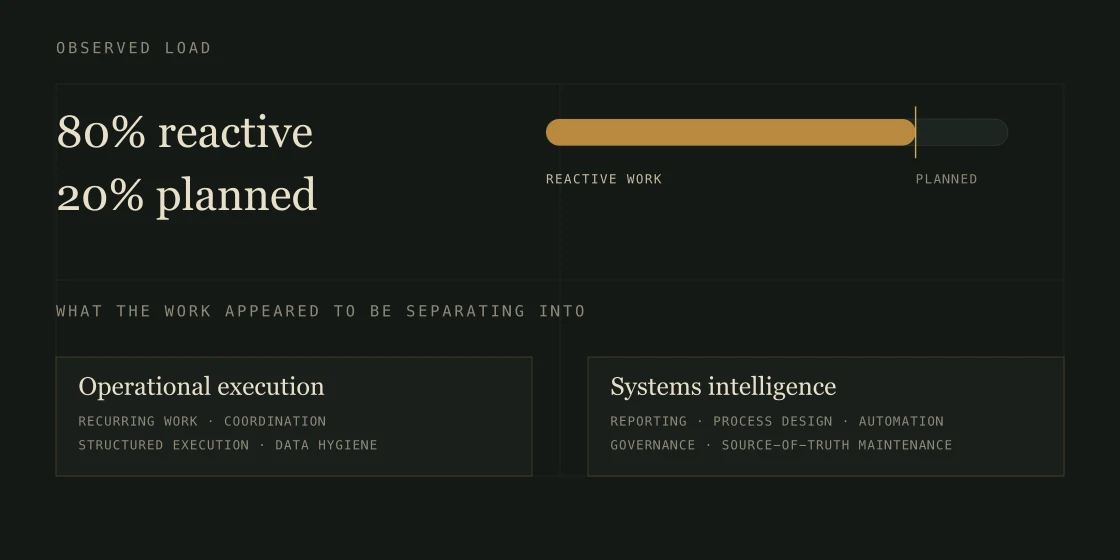
Inside the work, the split was roughly 80% reactive and 20% planned. Requests arrived without enough context to act safely. Almost everything was urgent. The planned work happened in whatever gaps were left.
But the reactivity had a pattern. A lot of it came from missing alignment and missing context upstream, not from the core job itself.
What I noticed
The obvious question was how to help one overloaded person keep up. That turned out to be the wrong question.
The role was repeatedly filling in missing context, definitions, ownership, priority, and memory. One capable person had become the human integration layer for an operating model that did not have those things anywhere else.
When every request is called urgent, urgency stops carrying information. When the queue is invisible, a priority held in conversation can be undone by the next private request. And even perfect intake cannot solve overload if nobody can see whether the hours exist to do the work.
The diagnosis
The role wasn’t broken. The operating model was.
There was no canonical source of truth, no single intake path, no visible priority system, no capacity view, and no reliable restore point for high-risk changes.
The system had no shock absorber, so a person had become the shock absorber. Asking that person to work faster would only make the structural problem slightly less visible.
The proposed redesign
I proposed four structural fixes. One front door for requests. One maintained source of truth. Priority shown beside capacity, so overload becomes a leadership tradeoff instead of a personal-effort problem. And a safe recovery path before any high-risk change.
This was a redesign proposal based on firsthand coverage. It had not been implemented, so the proof here is the diagnosis and the operating model—not a claimed outcome.
The same observation suggested that the work was separating into two different capabilities: recurring operational execution, and the systems intelligence underneath it—reporting, process design, automation, governance, and source-of-truth maintenance. That was the pattern in this work, not a universal rule.
- 01One front door — a single visible intake and approval path
- 02One source of truth — maintained definitions, process, ownership, and canonical resources
- 03Visible priority + capacity — the order of work and whether the available hours can absorb it
- 04Safe recovery — a reliable prior-state snapshot before high-risk changes
What this proved
Sometimes the person absorbing the chaos is the reason the system appears to work.
Making that person faster does not fix the system. The work becomes redesignable when the hidden queue, missing context, capacity, ownership, and recovery risk become visible.
My recommendation was to test the proposed model in the high-change function where those gaps were easiest to see, then decide whether it deserved to travel any farther.