Case Study
I Didn’t Know How to Edit Video. So I Built the Tool Instead.
How one unfamiliar video effect became a reusable local generator with templates, MP4 export, saved presets, and privacy guardrails.
The problem
I saw a LinkedIn ad where part of the video looked like it came out of the post and into the feed.
My reaction was basically: How the hell did they do that?
I do not know how to edit video. I gave Codex the idea anyway and built a first prototype. It was not quite right.
We built another version. It was worse.
How to think about this problem
At that point, more tweaking was not the answer. I was guessing at the surface without understanding what was creating the illusion.
So I had Codex inspect what was actually happening: which parts stayed inside the post, which parts crossed the feed boundary, and how the timing made the effect feel real.
The goal was not to copy the advertiser’s creative. It was to understand the mechanics well enough to make my own version.
What it does
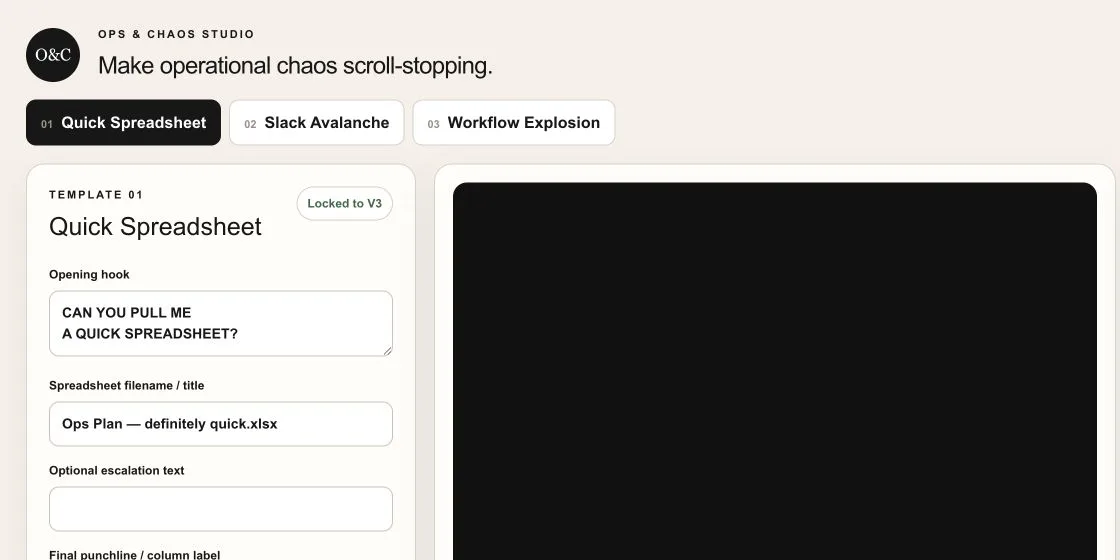
The finished local generator has multiple templates, configurable content, MP4 export, and saved presets so I can reuse an idea without rebuilding it.
It also has a privacy gate. Active templates use fictional sample data, and preview, preset, and export checks are designed to block prohibited terms before anything becomes public creative.
How it works
Once the mechanics made sense, I built my own version for Instagram, tested it inside the actual feed, adjusted it, and posted it.
Then I had a second thought: I do not want to have to figure all of that out again.
So the one-off implementation became a local tool that can generate the next version from a template instead of sending me back to the beginning.
- 01See an effect I do not know how to make
- 02Build two wrong versions
- 03Inspect the mechanics instead of guessing
- 04Create and test my own implementation
- 05Turn it into a reusable local generator
- 06Add privacy checks before reuse
Why it's helpful
The useful outcome was not that I became a video editor. I still do not consider myself one.
I learned enough about an unfamiliar problem to make something that worked in the real environment, then turned that new capability into a repeatable system.
I am less interested in whether AI can do the things I already know how to do. I am more interested in what happens when I look at something I do not know how to do and think: I can probably figure that out.
See it
A quick walkthrough of the problem, the tool, and what changed.
A public-safe prototype using fictional example data. No advertiser creative or employer material is included.