Case Study
The Automation Worked. That Wasn’t Enough.
Rebuilding a virtual-event reminder workflow was straightforward. Making the automation safe enough to trust was the real work.
The situation
A recurring virtual-event workflow had a frustrating tradeoff.
The webinar platform could send reminder emails automatically, but only when people registered through its own forms. Those forms cost us marketing attribution we cared about.
Moving registration to our marketing automation system fixed the attribution problem and still passed registrants into the webinar platform. But the reminder sequence disappeared.
The real problem
The obvious fix was to recreate the reminder emails in the system that should own them. That part was straightforward in theory.
Then the automation started creating real audiences, emails, schedules, and system records. The question changed from “Can this build the workflow?” to “Can I trust it to build the right thing without quietly causing damage?”
That second question mattered more. A failed request is annoying. A successful-looking automation that creates the wrong asset or includes the wrong audience is dangerous.
The build
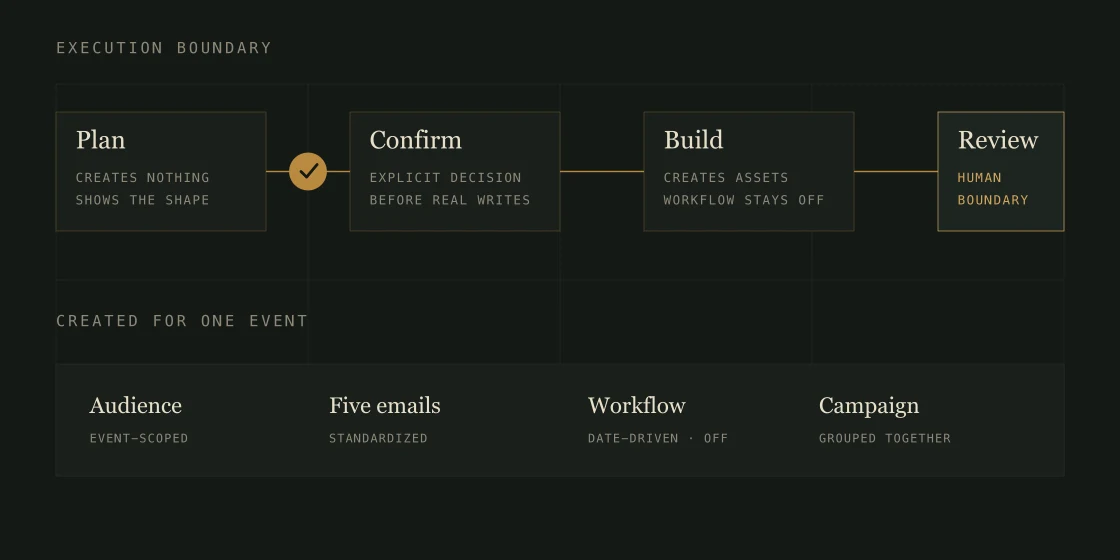
For each event, the tool creates one self-updating audience, five reminder emails, one date-driven workflow, and one campaign structure that keeps the assets together.
The default sequence covers confirmation, one week before, one day before, one hour before, and follow-up. The structure and copy repeat; the event details change.
It also scopes the audience to the event, adds calendar links, and starts from owned templates instead of cloning whatever email happens to be nearby.
The safety boundary
The tool separates planning from execution. Plan creates nothing and shows what will happen. Build requires explicit confirmation, creates the assets, and leaves the workflow switched off for human review.
The dry run looked right. The first real writes still exposed things it could not prove: an asset needed a different draft state, one setting silently created the wrong type of email, and a guessed audience-filter structure failed against the real system.
Instead of continuing to guess, I inspected an existing working example and used the structure the system actually accepted. Then I smoke-tested the full path safely and read the created assets back to check the wiring.
Real use exposed another quiet risk. Reusing one registration path across multiple events could mix audiences without looking obviously broken. Event-specific scoping was added before that became normal behavior.
The system kept getting more predictable: arbitrary clones became owned templates, copy became standardized, audience logic became event-safe, and separate assets gained a shared campaign structure. Those improvements came from using the thing, not pretending the first design was finished.
- 01Plan — show the audience, emails, timing, and grouping without creating anything
- 02Confirm — require an explicit decision before any real write
- 03Build — create the event assets in the real system
- 04Review — read back the output and leave the workflow switched off
What this proved
The tool successfully built one real event end to end: the audience, five emails, workflow, and campaign. The assets were read back and checked after creation.
What this proved was not that event reminders can be automated. It was that automation writing to real systems needs a stronger standard than “the plan looked right.”
The real environment has to accept it. The output has to be verified. Silent failure modes have to be considered. And consequential automation should stop at a human review boundary before it can act.